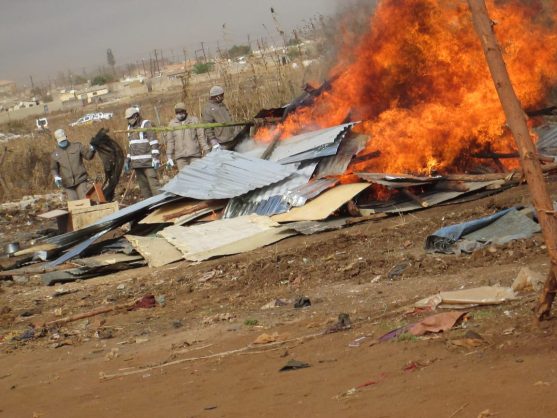
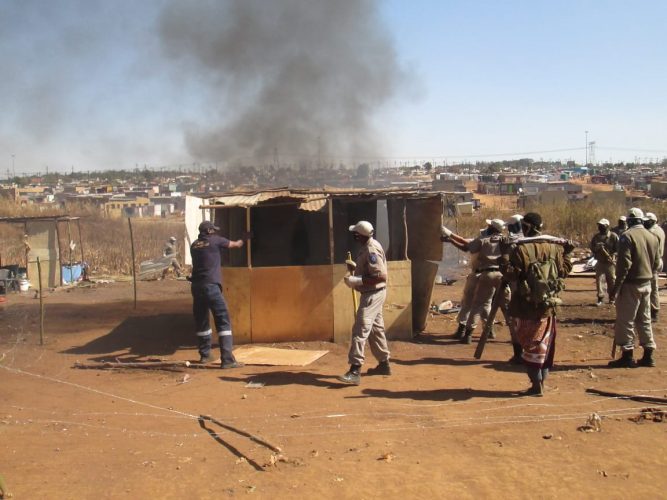
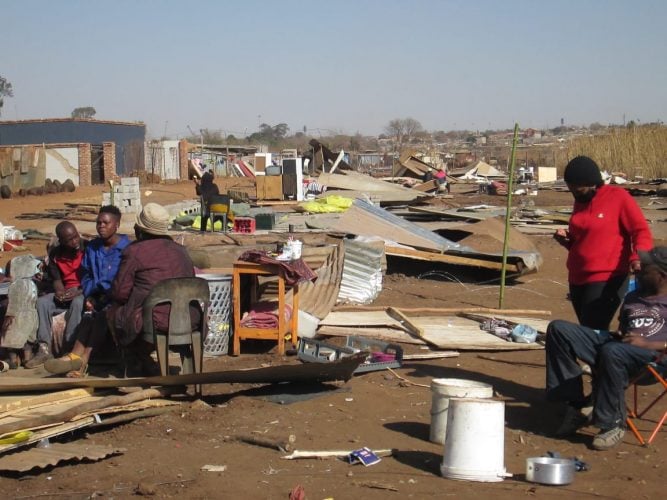
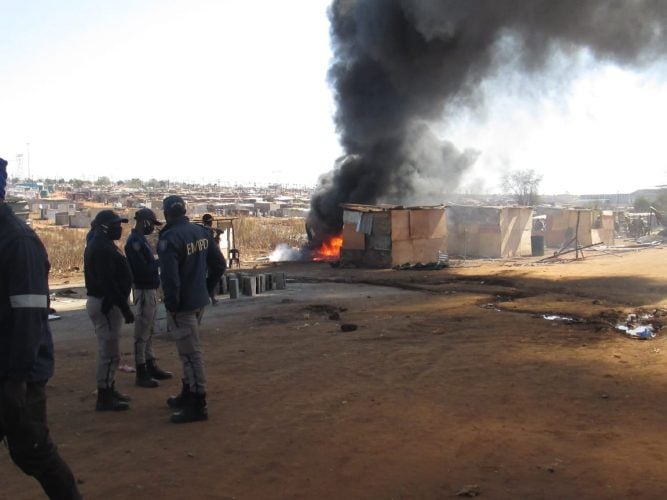
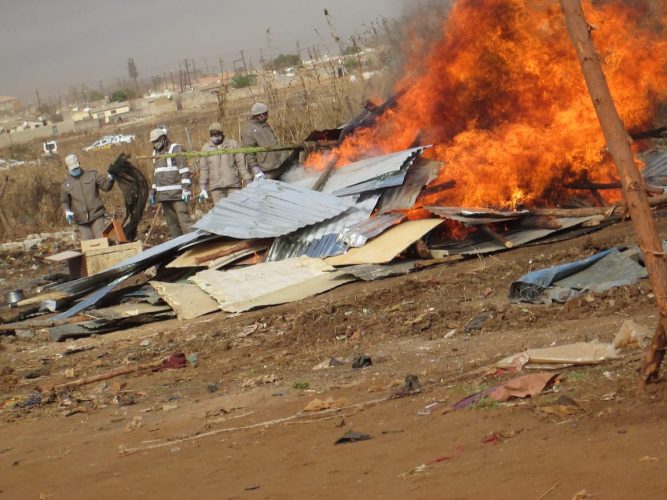
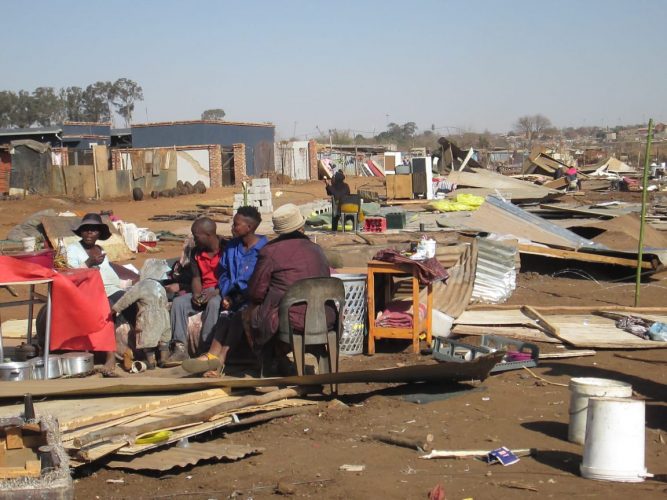
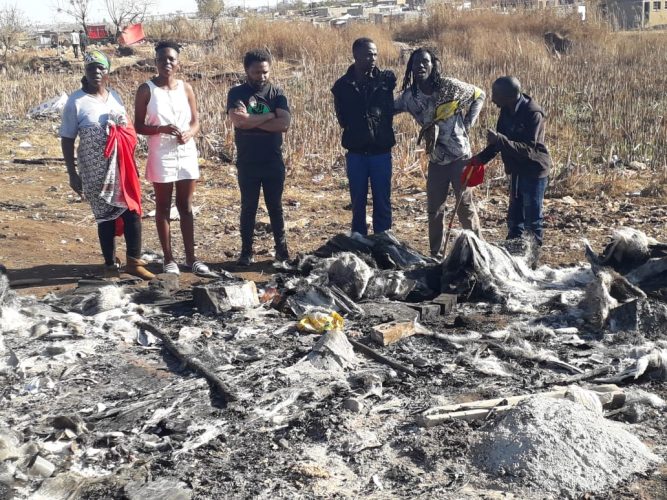
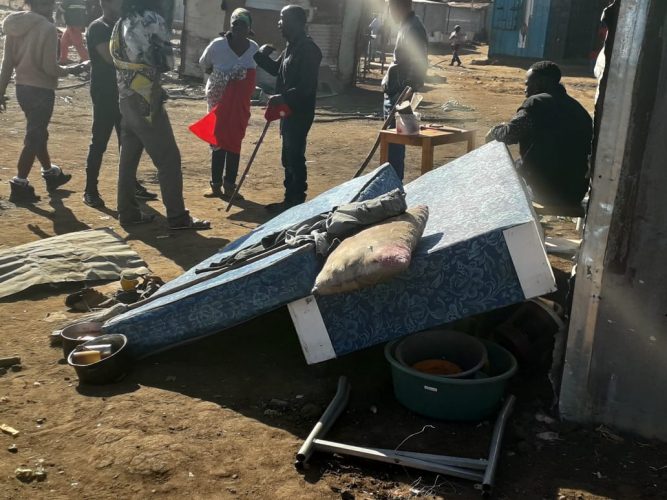
In a statement on July 28, mayor Dan Plato lamented that “420 law- abiding citizens” recently had their rights undermined by an “illegal land invasion” on a site earmarked for state-subsidised housing.
Although a later joint statement with Minister Lindiwe Sisulu suggested a more nuanced approach to the City’s alleged increase in land occupations, the narrative that pits “land invaders” against those who have “waited patiently” on the housing list has become a common refrain in official statements.
Many land occupiers are on the “housing waiting lists” too.
While waiting, many have endured conditions that materially undermine their rights on a daily basis for years – often decades. And many – who in all other respects are law-abiding – were faced with difficult choices as the Covid-19 pandemic and its economic impact hit their households.
As Reclaim the City leader Karen Hendricks regularly reminds us: people cannot live in a waiting list, least of all at a time when to stay home is to stay safe. How did we get here? The answer is clear: while the occupied site is officially named Izwe Lethu (“our country “or “our land”), its nickname is “Covid”.
Almost everyone living there directly connects their occupation to the economic impact of Covid-19 and an urgent need for land to live on when paying their rent became impossible. “Land invasion” is language that suggests self-interest or even criminal intent as opposed to urgent need.
It conceals the fact that the poor have borne, and will continue to bear, the brunt of the Covid-19 economic fallout. According to the recent Nids-Cram survey, three million South Africans lost their jobs and a further 1.5million lost their income between February and April this year.
One-in-three income earners in February did not earn an income in April. The vast majority of these job losses were concentrated among already disadvantaged groups.
Women were particularly hard hit, making up two million of the three million job losses.
Even wealthier families have struggled with this. A recent nationwide survey of 80,000 tenants, found that the majority are struggling to pay their rent as a result of the Covid-19 outbreak and national lockdown.
The survey found that only 37% of tenants can afford to pay their full rent and that a massive 22% of tenants cannot pay their rent at all.
But rather than acknowledge the complexity of a global pandemic compounding an existing housing crisis, the City seems to have decided that it is easier to criminalise desperation.
This is not to suggest that all land occupations are free from criminal activities. There is also no denying that some land occupations and protests may have an impact on planned service delivery projects.
The City housing backlog stood at 365,000 families last year and is growing by 16,000 to 18,000 a year.
In 2018/2019, the City provided and upgraded only 5,692 homes.
At this rate, the City itself believes that it will be over 70 years before it can eradicate the housing backlog.
Despite this, we are yet to see the rapid release of well-located state-owned land for redistributive housing for black, coloured and Indian families.
What is true is that evictions and the threat thereof have sky-rocketed despite the nationwide prohibition on evictions. During the level 5 lockdown, the number of unique visitors to the website www.evictions.org.za (an online portal offering legal advice to tenants and unlawful occupiers facing eviction) soared nearly tenfold from a pre-lockdown monthly average of 300 to 2,900 in May.
By the middle of last month, roughly 57% of calls to the Access to Justice Legal Support Hotline (a hotline set up to provide legal advice during the national lockdown) came from people seeking legal advice for eviction issues. While accurate numbers on evictions do not exist in Cape Town, the drastic increase in people seeking support for eviction issues through these two channels alone clearly indicates that evictions are happening at scale.
An overwhelming number of people are currently faced with an untenable choice between spending money on rent or feeding their families – often leaving them with no financial means to hold on to housing. And it is further true that many landlords in the backyard rental market (which constitutes a significant portion of South Africa’s affordable housing stock) are themselves unemployed and cannot be expected to absorb the impact of non-payment alone.
Despite the extraordinary circumstances that surround the apparent rise in land occupations, the City speaks of “land invasion” without reference to the context. They offer one story, but there is another one – in fact, there are many. Beyond the tales, individual occupiers might tell of Covid-19 struggles faced without adequate relief, there are the stories of street-based people fined for being on the street and of the City trying to pass by-laws that allow for their forced removal.
There are the stories of prior mass evictions like those at Lwandle.
There are the stories of City decisions to sell off or lease out well-located public land that could be used for the development of affordable housing while allowing unreasonable delays on housing promises made.
These stories paint a portrait of a City that will not make room for poor and working-class people.
So is it surprising that people have tried to make room for themselves?
In early April, former UN Special Rapporteur on Housing Leilani Farha released a guidance note on how states could mitigate the impact of Covid-19 on the right to housing. The core principles urge states to ensure that the burden of responses to this pandemic be shared across society in a fair and equitable manner, with the financial impact absorbed as far as possible by those with greater financial capacity.
We have not been able to do this.
Instead, after decades of state neglect, the poor and working class have largely been left to shoulder this crisis alone. Not only has the state failed to protect people from de facto eviction during this time, but the City has gone further by criminalising and vilifying people’s attempts to make a home for themselves.
At the end of the day, there are no clear lines, no heroes or demons.
There are only human beings navigating increasingly challenging circumstances and making complex choices – often within a limited range of possibilities.
Reprinted from IOL by Deena Bosch, Kyla Hazell and Michael Clarke
Simon Dippenaar & Associates, Inc. is a firm of specialist eviction lawyers, based in Cape Town and now operating in Johannesburg and Durban, helping both landlords and tenants with the eviction process. Contact one of our attorneys on 086 099 5146 or sdippenaar@sdlaw.co.za if you need advice on the eviction process or if you are facing unlawful eviction.
Further Reading: