Tag

eviction attorneys South Africa Archives | Page 5 of 7 | Eviction Lawyers South Africa

Rental tenants believe they can only pay rent after a 10% reduction

By | Eviction news, Eviction notice, Eviction orders, Evictions, Rent
About 88 percent of rental tenants believe they will only be able to afford monthly rentals that’s reduced by 10 percent for the next 12 months, while more than a third say they intend to move for a better deal, due to the impact of the Covid-19 lockdown. Picture Pixabay

CAPE TOWN – About 88 percent of rental tenants believe they will only be able to afford monthly rentals that’s reduced by 10 percent for the next 12 months, while more than a third say they intend to move for a better deal, due to the impact of the Covid-19 lockdown.

These were according to findings of a survey by digital rental platform, HouseME, among more than 1000 of its tenants and landlords in June and July.

The findings reveal the impact of the Covid-19 lockdown and economic slowdown on the residential property market, in stark black and white, and a major concern is when the payment holidays end.

Property entrepreneur and Only Realty managing director Grant Smee said: “We’ are seeing an excess amount of vacant properties. Tenants have either: been evicted; had to move out due to affordability; or, in the case of Airbnb’s, are vacant due to a lack of tourism. This is particularly evident in Cape Town, our major tourism hub”.

Smee said while evictions had been an ethical “grey area” during lockdown, eviction lawyers were preparing for an influx of cases. He said the topic of eviction, however, remained contentious, and was placing big pressure on both landlords and tenants.

In the HouseME survey, the majority of landlords (85 percent) in the HouseME survey own bonded properties, so it was unsurprising that 37 percent said they could not afford to self-fund more than one month of vacancy, with half of those landlords indicating they could not fund even a single month of vacancy.

However, 41 percent of landlords were expecting rentals to remain unchanged for the next 12 months, and 24 percent expected rentals to increase.

With 28 percent of tenants already having had their income negatively affected, either through job loss or salary reduction, and 21 percent concerned about income security in the next six months, the mismatch of expectations between landlords and tenants was likely to cause tension when it comes to property pricing and negotiation, said HouseME chief executive Ben Shaw.

“A major concern for landlords, banks and property managers is what will happen when the payment holidays end. Landlords who have had the benefit of delaying home loan repayments may now be forced to ruthlessly pursue rental to cover their payments,” he said.

Tenants who had rental payment holidays could now also be within days of default.

“We expect the national default rate to spike in August and September and this will have a knock-on effect on property value, credit records and general affordability by the consumer,” said Shaw.

A quarter of all landlords surveyed listed non-payment of rental as their biggest worry going forward, followed by vacancies (19 percent) and late payments (16 percent).

“The economic recession is already biting hard among tenants, with some respondents saying that moving costs are prohibitive given their current liquidity position, and some even citing petrol and travel costs for viewings as a barrier,” said Shaw.

Shaw said the pandemic had fast-tracked the move to digital, which was reflected in accelerated adoption of the HouseME platform.

“We have seen an 80 percent jump in units advertised since the first quarter of the year; driven by larger property portfolios – all of whom are now moving digital, seeking the cost efficiencies of a long-term letting platform.

“Our listings climbed from an average of 400 pre-lockdown to more than 750 in July. This was partly due to the influx of fully-furnished holiday-let units now seeking long-term tenants, because they could no longer rely on the short-term market for income.

“This increased supply is likely to further push down rental prices, particularly in major cities – both tourist and business centres – until tourism picks up again,” said Shaw.

Smee said a prolonged buyers’ market had seen a spike in residential property sales since June. “It is important to take a conservative, calculated and logical approach when purchasing or selling a property,” he said.

Reprinted from Iol by Edward West (emphasis by SD Law*)

Simon Dippenaar & Associates, Inc. is a firm of specialist eviction lawyers, based in Cape Town and now operating in Johannesburg and Durban, helping both landlords and tenants with the eviction process. Contact one of our eviction attorneys on 086 099 5146 or sdippenaar@sdlaw.co.za if you need advice on the eviction process or if you are facing unlawful eviction.

Further Reading:
Campaigns failing to stop farm evictions, say civil society organisations

By | COVID 19, Eviction news, Eviction notice, Eviction orders, Farm evictions

Webinar highlights plight of women on farms, calls on President to honour promise

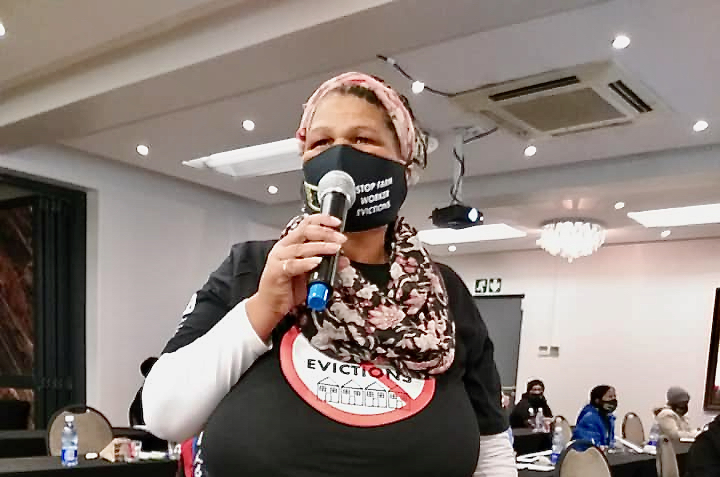
Photo of a woman with a microphone

Johanna Fransman was evicted from Soetendal farm and relocated to New Rest. She says she lost her son in January this year in a shack fire at New Rest. “I feel very disappointed in the municipality who say that they cannot give us houses. Our children are anxious to be outside, and you cannot even walk outside at night. I don’t want to be where I live,” she said.

  • Women who live on farms raised their concerns at a webinar hosted by various civil society organisations, saying little has changed for them since apartheid officially ended.
  • Thousands of people are facing evictions in the Boland.
  • The organisations compiled a memorandum of demands sent to the Department of Agriculture, Land reform and Rural Development.

Members of the Women on Farms Project (WFP) say despite campaigns, talk of stopping evictions on farms and the Covid-19 pandemic, thousands of people face becoming homeless as eviction orders continue to be approved by the courts.

The women raised their concerns at an online webinar on Tuesday, held in partnership with Mawubuye Land Rights Forum, the Social Justice Coalition, and the Legal Resources Centre.

They demanded that President Cyril Ramaphosa sign a moratorium on farm evictions, which they say he promised farmworkers in De Doorns and Paarl in 2014.

The WFP compiled a memorandum with a list of demands to put to the Department of Agriculture, Land reform and Rural Development. These include: the provision of land and decent housing for evicted farmworkers, ensuring that evictions are not granted if there is no land for alternative housing, and that government accelerate Land Expropriation without Compensation.

Director of WFP Colette Solomon said although the country celebrates 26 years of democracy, farmers “still have all the power, all the money and all the wealth”. She said, “Farmworkers, specifically women on farms, are becoming poorer. There are fewer jobs available; people are working for fewer hours; there’s more retrenchments and evictions.”

“There is more protection for farmworkers in terms of the laws but in terms of the structure of our society in rural areas, the structure is still the same [as during apartheid].

Co-director Carmen Louw said the evictions of farmworkers is a recurring issue despite the attempts of several organisations and campaigns to stop it.

“In the Drakenstein Municipality, there are more than a thousand cases on the current roll that are awaiting an outcome, and in most cases an eviction order will be granted. So, despite numerous and yearlong fights, many magistrates and land claims courts endorse these eviction orders.”

“We’ve got a supposedly superior Constitution but there’s basically no difference to the life that women in 1956 experienced in urban areas than what women on farms are still experiencing today,” said Louw.

The webinar was joined by several of the women from the Drakenstein area who were evicted from the Soetendal farm in 2015. They shared their experiences of being relocated by Drakenstein Municipality to an open plot in New Rest informal settlement. Diana Meyer of WFP and her family were among them. She said the eviction was a traumatic experience for the community.

“There weren’t proper doors or a proper foundation for the houses. Our things were thrown out and broken, while our children stood watching in confusion,” she said.

Meyers said her family do not feel safe where they now live and their living conditions are worse than when they lived on the farm.

“We feel so helpless. I just want the government to help us. We long for proper houses and for the government to give us a piece of land so that we can farm and have food to put on the table,” said Mayers.

Dawn Jacobs, of Drakenstein Civics, said that some farmers have forced workers to leave by cutting off the supply of water and electricity to their homes.

“When people are evicted and go to the municipality, they always say there’s no land available for houses and no land available for farmworkers. But the municipality is quick to approve land for private development,” said Jacobs.

“We don’t want to stay in shacks or townships. We want to remain on the farms,” she said.

The women also spoke of the violence used by law enforcement and the Red Ants when evicting farm workers, despite a moratorium on all evictions during the Covid-19 pandemic.

Denia Jansen, of Mawubuye Land Rights Movement, said they had held several engagements with the Langeberg municipality regarding police brutality but to no avail.

“There’s no clear answer as to why they are using the Red Ants and law enforcement to evict people during this pandemic,” she said.

“Nothing will change until we stand united and unite our struggles regardless of which organisations we belong to. We all need to campaign for the same thing.”

Reprinted from GroundUp by

Simon Dippenaar & Associates, Inc. is a firm of specialist eviction lawyers, based in Cape Town and now operating in Johannesburg and Durban, helping both landlords and tenants with the eviction process. Contact one of our attorneys on 086 099 5146 or sdippenaar@sdlaw.co.za if you need advice on the eviction process or if you are facing unlawful eviction.

Further Reading:

Residents upset after Hangberg ruling

By | Eviction news, Eviction notice, Eviction orders, Eviction videos, Evictions

‘Very upset’ residents called Plato after Hangberg ruling, he tells Parliament

Reprinted from News 24 by Jan Gerber

Dan Plato. (Netwerk24)

Dan Plato. (Netwerk24)
  • Cape Town Mayor Dan Plato said he received many calls from disgruntled residents after the Western Cape High Court ordered the City to rebuild a house in Hangberg which it had demolished.
  • He said one house was preventing a development on the site, which residents were looking forward to.
  • The mayor said the City must protect its land, otherwise it won’t be able to build proper houses.

Cape Town Mayor Dan Plato said he received many calls from Hangberg residents who were “very upset” about a High Court ruling ordering the City to rebuild a house it had demolished in the area.Plato and his team were briefing the Portfolio Committee on Cooperative Governance and Traditional Affairs on the City’s human settlements policy.

In the court ruling, Judge Gayaat Salie-Hlophe ordered the City to immediately rebuild Ginola Phillips’ demolished house to the same size and dimensions it was, describing the City’s conduct as “deplorable, grotesque and without care for human dignity”.

News24 reported that the City was considering its options because the order to rebuild the single illegal Wendy house jeopardised the construction of a “valuable community facility”, which included a five-a-side soccer pitch.

A group called the Community of Hangberg, brought the application as the first applicant, with Phillips as the second, in response to the City of Cape Town’s dismantling of Phillips’ home in Hangberg, Hout Bay, twice in June. The City of Cape Town was the first respondent and Plato was the second.

“Mayor, I want to ask you, how do you feel after losing the court case?” EFF MP Hlengiwe Mkhaliphi asked.

“Most of the time, you run to the court, most of the time you win. This time you lost.”

She said they knew very well that the poorest of the poor couldn’t afford to defend themselves in court.

“Yes, it was negative for the City,” Plato responded. He added that they offered Phillips alternative sites on two occasions, but that he refused.

The City of Cape Town has been ordered by the High Court to rebuild a man’s small wendy-house home – within 48 hours. But in response, the City has advised it is “considering its options regarding the judgment”.

He told the committee he received lots of calls from residents “very upset” with the ruling because they were looking forward to the services that would have been provided through the City’s use of the site.

One house was stopping the development of the site, he pointed out.

“Many people abuse the lockdown measures,” he said. “They abuse the regulations for their own interests.”

Mkhaliphi also asked if he tried to contact Bulelani Qolani, a man who was dragged out of his house naked by City law enforcement officials in Khayelitsha.

Plato said he tried to and asked community organisations in Khayelitsha to help him track the man down.

“But I got the sense he doesn’t want to talk to me,” Plato said.

“We are not heartless,” Plato said.

“We are not excited about evictions.”

Simon Dippenaar & Associates, Inc. is a firm of specialist eviction lawyers, based in Cape Town and now operating in Johannesburg and Durban, helping both landlords and tenants with the eviction process. Contact one of our attorneys on 086 099 5146 or sdippenaar@sdlaw.co.za if you need advice on the eviction process or if you are facing unlawful eviction.

Further Reading: