Tag

Cape Town eviction lawyer Archives | Page 6 of 7 | Eviction Lawyers South Africa

Poor working class citizens are losing ground in the battle for adequate housing

By | COVID 19, Eviction news, Eviction notice, Eviction orders, Evictions, Homeless
Illegal land occupation in Cape Town is a pressing problem and many occupiers are not be on the housing waiting list, say the writers. File picture: Phando Jikelo/African News Agency

In a statement on July 28, mayor Dan Plato lamented that “420 law- abiding citizens” recently had their rights undermined by an “illegal land invasion” on a site earmarked for state-subsidised housing.

Although a later joint statement with Minister Lindiwe Sisulu suggested a more nuanced approach to the City’s alleged increase in land occupations, the narrative that pits “land invaders” against those who have “waited patiently” on the housing list has become a common refrain in official statements.

Many land occupiers are on the “housing waiting lists” too.

While waiting, many have endured conditions that materially undermine their rights on a daily basis for years – often decades. And many – who in all other respects are law-abiding – were faced with difficult choices as the Covid-19 pandemic and its economic impact hit their households.

As Reclaim the City leader Karen Hendricks regularly reminds us: people cannot live in a waiting list, least of all at a time when to stay home is to stay safe. How did we get here? The answer is clear: while the occupied site is officially named Izwe Lethu (“our country “or “our land”), its nickname is “Covid”.

Almost everyone living there directly connects their occupation to the economic impact of Covid-19 and an urgent need for land to live on when paying their rent became impossible. “Land invasion” is language that suggests self-interest or even criminal intent as opposed to urgent need.

It conceals the fact that the poor have borne, and will continue to bear, the brunt of the Covid-19 economic fallout. According to the recent Nids-Cram survey, three million South Africans lost their jobs and a further 1.5million lost their income between February and April this year.

One-in-three income earners in February did not earn an income in April. The vast majority of these job losses were concentrated among already disadvantaged groups.

Women were particularly hard hit, making up two million of the three million job losses.

Even wealthier families have struggled with this. A recent nationwide survey of 80,000 tenants, found that the majority are struggling to pay their rent as a result of the Covid-19 outbreak and national lockdown.

The survey found that only 37% of tenants can afford to pay their full rent and that a massive 22% of tenants cannot pay their rent at all.

But rather than acknowledge the complexity of a global pandemic compounding an existing housing crisis, the City seems to have decided that it is easier to criminalise desperation.

This is not to suggest that all land occupations are free from criminal activities. There is also no denying that some land occupations and protests may have an impact on planned service delivery projects.

The City housing backlog stood at 365,000 families last year and is growing by 16,000 to 18,000 a year.

In 2018/2019, the City provided and upgraded only 5,692 homes.

At this rate, the City itself believes that it will be over 70 years before it can eradicate the housing backlog.

Despite this, we are yet to see the rapid release of well-located state-owned land for redistributive housing for black, coloured and Indian families.

What is true is that evictions and the threat thereof have sky-rocketed despite the nationwide prohibition on evictions. During the level 5 lockdown, the number of unique visitors to the website www.evictions.org.za (an online portal offering legal advice to tenants and unlawful occupiers facing eviction) soared nearly tenfold from a pre-lockdown monthly average of 300 to 2,900 in May.

By the middle of last month, roughly 57% of calls to the Access to Justice Legal Support Hotline (a hotline set up to provide legal advice during the national lockdown) came from people seeking legal advice for eviction issues. While accurate numbers on evictions do not exist in Cape Town, the drastic increase in people seeking support for eviction issues through these two channels alone clearly indicates that evictions are happening at scale.

An overwhelming number of people are currently faced with an untenable choice between spending money on rent or feeding their families – often leaving them with no financial means to hold on to housing. And it is further true that many landlords in the backyard rental market (which constitutes a significant portion of South Africa’s affordable housing stock) are themselves unemployed and cannot be expected to absorb the impact of non-payment alone.

Despite the extraordinary circumstances that surround the apparent rise in land occupations, the City speaks of “land invasion” without reference to the context. They offer one story, but there is another one – in fact, there are many. Beyond the tales, individual occupiers might tell of Covid-19 struggles faced without adequate relief, there are the stories of street-based people fined for being on the street and of the City trying to pass by-laws that allow for their forced removal.

There are the stories of prior mass evictions like those at Lwandle.

There are the stories of City decisions to sell off or lease out well-located public land that could be used for the development of affordable housing while allowing unreasonable delays on housing promises made.

These stories paint a portrait of a City that will not make room for poor and working-class people.

So is it surprising that people have tried to make room for themselves?

In early April, former UN Special Rapporteur on Housing Leilani Farha released a guidance note on how states could mitigate the impact of Covid-19 on the right to housing. The core principles urge states to ensure that the burden of responses to this pandemic be shared across society in a fair and equitable manner, with the financial impact absorbed as far as possible by those with greater financial capacity.

We have not been able to do this.

Instead, after decades of state neglect, the poor and working class have largely been left to shoulder this crisis alone. Not only has the state failed to protect people from de facto eviction during this time, but the City has gone further by criminalising and vilifying people’s attempts to make a home for themselves.

At the end of the day, there are no clear lines, no heroes or demons.

There are only human beings navigating increasingly challenging circumstances and making complex choices – often within a limited range of possibilities.

Reprinted from IOL by Deena Bosch, Kyla Hazell and Michael Clarke

Simon Dippenaar & Associates, Inc. is a firm of specialist eviction lawyers, based in Cape Town and now operating in Johannesburg and Durban, helping both landlords and tenants with the eviction process. Contact one of our attorneys on 086 099 5146 or sdippenaar@sdlaw.co.za if you need advice on the eviction process or if you are facing unlawful eviction.

Further Reading:

Group petitions against eviction to remain living at old Observatory circus school

By | Eviction news, Eviction orders, Evictions
Group staying at old circus school in Observatory are petitioning the City to lease the property to the residents. Picture: Marvin Charles/Cape Argus

Cape Town – A group of people who have been illegally staying at the former SA National Circus School next to Hartleyvale Stadium in Observatory are petitioning the City to lease the property to the residents.

The calls come after several failed negotiations with the City, with eviction orders having been served.

The petition addressed to mayor Dan Plato stated: “As Observatory residents and supporters from outside the suburb, we call on the City of Cape Town to halt current attempts to evict residents on the property at 2 Willow Road, Observatory, and enter into negotiations with the Observatory Civic Association and the Willow Arts Collective towards leasing the old circus school land for this innovative community-driven project.”

The Willow Arts Collective is a community project based within the Hartleyvale sports precinct in Observatory, Cape Town, and it has begun to turn a neglected piece of land into an urban vegetable garden that provides locally grown, organic vegetables for the community.

Resident Moyo Uno said: “We aim to lease or purchase the City of Cape Town-owned property , formerly known as the SA National Circus, and turn it into the first multi-use centre for heritage, arts, recreation and sustainable living in the Southern Suburbs.”

So far, the petition has more than 800 signatures and residents have until August 15 to make their voices heard. At least 24 residents have been staying on the property.

Since 2018, they have been served with eviction notices from the City, which wants to use the land for sport and recreational activities. Last month, the eviction case was postponed and the magistrate ordered the parties to hold meaningful engagements.

Mayco member for community services and health Zahid Badroodien said: “Unfortunately, as you know, the previous leaseholder had illegally been subletting the land to individuals that have since grown in number and have further begun to use the land outside of its intended sporting purposes.

“The Hartleyvale sporting precinct boasts a proud heritage as a community sport facility but current unauthorised activities are not only threatening this asset, but its continued use as a recreational space. The City has and will continue to engage with the occupiers to offer alternative forms of accommodation which have up to now been refused.”

Reprinted from IOL by Marvin Charles

Simon Dippenaar & Associates, Inc. is a firm of specialist eviction lawyers, based in Cape Town and now operating in Johannesburg and Durban, helping both landlords and tenants with the eviction process. Contact one of our attorneys on 086 099 5146 or sdippenaar@sdlaw.co.za if you need advice on the eviction process or if you are facing unlawful eviction.

Further Reading:
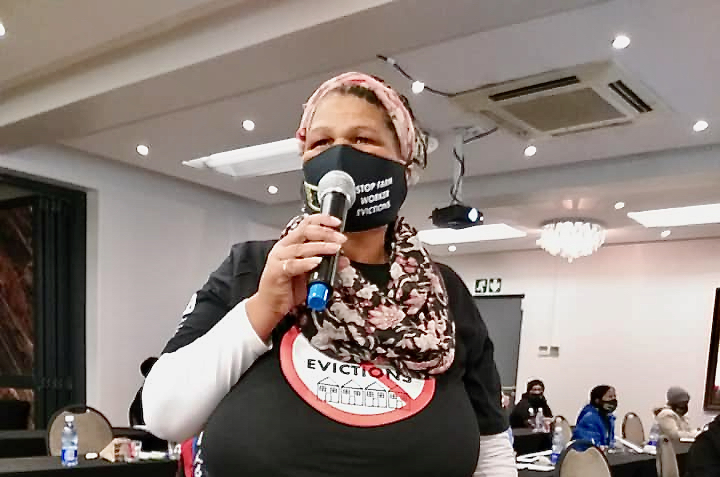
 

Campaigns failing to stop farm evictions, say civil society organisations

By | COVID 19, Eviction news, Eviction notice, Eviction orders, Farm evictions

Webinar highlights plight of women on farms, calls on President to honour promise

Photo of a woman with a microphone

Johanna Fransman was evicted from Soetendal farm and relocated to New Rest. She says she lost her son in January this year in a shack fire at New Rest. “I feel very disappointed in the municipality who say that they cannot give us houses. Our children are anxious to be outside, and you cannot even walk outside at night. I don’t want to be where I live,” she said.

  • Women who live on farms raised their concerns at a webinar hosted by various civil society organisations, saying little has changed for them since apartheid officially ended.
  • Thousands of people are facing evictions in the Boland.
  • The organisations compiled a memorandum of demands sent to the Department of Agriculture, Land reform and Rural Development.

Members of the Women on Farms Project (WFP) say despite campaigns, talk of stopping evictions on farms and the Covid-19 pandemic, thousands of people face becoming homeless as eviction orders continue to be approved by the courts.

The women raised their concerns at an online webinar on Tuesday, held in partnership with Mawubuye Land Rights Forum, the Social Justice Coalition, and the Legal Resources Centre.

They demanded that President Cyril Ramaphosa sign a moratorium on farm evictions, which they say he promised farmworkers in De Doorns and Paarl in 2014.

The WFP compiled a memorandum with a list of demands to put to the Department of Agriculture, Land reform and Rural Development. These include: the provision of land and decent housing for evicted farmworkers, ensuring that evictions are not granted if there is no land for alternative housing, and that government accelerate Land Expropriation without Compensation.

Director of WFP Colette Solomon said although the country celebrates 26 years of democracy, farmers “still have all the power, all the money and all the wealth”. She said, “Farmworkers, specifically women on farms, are becoming poorer. There are fewer jobs available; people are working for fewer hours; there’s more retrenchments and evictions.”

“There is more protection for farmworkers in terms of the laws but in terms of the structure of our society in rural areas, the structure is still the same [as during apartheid].

Co-director Carmen Louw said the evictions of farmworkers is a recurring issue despite the attempts of several organisations and campaigns to stop it.

“In the Drakenstein Municipality, there are more than a thousand cases on the current roll that are awaiting an outcome, and in most cases an eviction order will be granted. So, despite numerous and yearlong fights, many magistrates and land claims courts endorse these eviction orders.”

“We’ve got a supposedly superior Constitution but there’s basically no difference to the life that women in 1956 experienced in urban areas than what women on farms are still experiencing today,” said Louw.

The webinar was joined by several of the women from the Drakenstein area who were evicted from the Soetendal farm in 2015. They shared their experiences of being relocated by Drakenstein Municipality to an open plot in New Rest informal settlement. Diana Meyer of WFP and her family were among them. She said the eviction was a traumatic experience for the community.

“There weren’t proper doors or a proper foundation for the houses. Our things were thrown out and broken, while our children stood watching in confusion,” she said.

Meyers said her family do not feel safe where they now live and their living conditions are worse than when they lived on the farm.

“We feel so helpless. I just want the government to help us. We long for proper houses and for the government to give us a piece of land so that we can farm and have food to put on the table,” said Mayers.

Dawn Jacobs, of Drakenstein Civics, said that some farmers have forced workers to leave by cutting off the supply of water and electricity to their homes.

“When people are evicted and go to the municipality, they always say there’s no land available for houses and no land available for farmworkers. But the municipality is quick to approve land for private development,” said Jacobs.

“We don’t want to stay in shacks or townships. We want to remain on the farms,” she said.

The women also spoke of the violence used by law enforcement and the Red Ants when evicting farm workers, despite a moratorium on all evictions during the Covid-19 pandemic.

Denia Jansen, of Mawubuye Land Rights Movement, said they had held several engagements with the Langeberg municipality regarding police brutality but to no avail.

“There’s no clear answer as to why they are using the Red Ants and law enforcement to evict people during this pandemic,” she said.

“Nothing will change until we stand united and unite our struggles regardless of which organisations we belong to. We all need to campaign for the same thing.”

Reprinted from GroundUp by

Simon Dippenaar & Associates, Inc. is a firm of specialist eviction lawyers, based in Cape Town and now operating in Johannesburg and Durban, helping both landlords and tenants with the eviction process. Contact one of our attorneys on 086 099 5146 or sdippenaar@sdlaw.co.za if you need advice on the eviction process or if you are facing unlawful eviction.

Further Reading: