Tag

Eviction attorney Archives | Page 6 of 12 | Eviction Lawyers South Africa

Campaigns failing to stop farm evictions, say civil society organisations

By | COVID 19, Eviction news, Eviction notice, Eviction orders, Farm evictions

Webinar highlights plight of women on farms, calls on President to honour promise
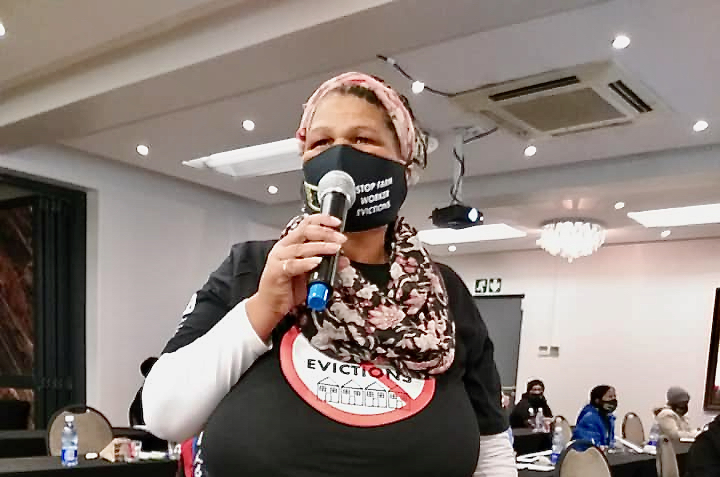
Photo of a woman with a microphone

Johanna Fransman was evicted from Soetendal farm and relocated to New Rest. She says she lost her son in January this year in a shack fire at New Rest. “I feel very disappointed in the municipality who say that they cannot give us houses. Our children are anxious to be outside, and you cannot even walk outside at night. I don’t want to be where I live,” she said.

  • Women who live on farms raised their concerns at a webinar hosted by various civil society organisations, saying little has changed for them since apartheid officially ended.
  • Thousands of people are facing evictions in the Boland.
  • The organisations compiled a memorandum of demands sent to the Department of Agriculture, Land reform and Rural Development.

Members of the Women on Farms Project (WFP) say despite campaigns, talk of stopping evictions on farms and the Covid-19 pandemic, thousands of people face becoming homeless as eviction orders continue to be approved by the courts.

The women raised their concerns at an online webinar on Tuesday, held in partnership with Mawubuye Land Rights Forum, the Social Justice Coalition, and the Legal Resources Centre.

They demanded that President Cyril Ramaphosa sign a moratorium on farm evictions, which they say he promised farmworkers in De Doorns and Paarl in 2014.

The WFP compiled a memorandum with a list of demands to put to the Department of Agriculture, Land reform and Rural Development. These include: the provision of land and decent housing for evicted farmworkers, ensuring that evictions are not granted if there is no land for alternative housing, and that government accelerate Land Expropriation without Compensation.

Director of WFP Colette Solomon said although the country celebrates 26 years of democracy, farmers “still have all the power, all the money and all the wealth”. She said, “Farmworkers, specifically women on farms, are becoming poorer. There are fewer jobs available; people are working for fewer hours; there’s more retrenchments and evictions.”

“There is more protection for farmworkers in terms of the laws but in terms of the structure of our society in rural areas, the structure is still the same [as during apartheid].

Co-director Carmen Louw said the evictions of farmworkers is a recurring issue despite the attempts of several organisations and campaigns to stop it.

“In the Drakenstein Municipality, there are more than a thousand cases on the current roll that are awaiting an outcome, and in most cases an eviction order will be granted. So, despite numerous and yearlong fights, many magistrates and land claims courts endorse these eviction orders.”

“We’ve got a supposedly superior Constitution but there’s basically no difference to the life that women in 1956 experienced in urban areas than what women on farms are still experiencing today,” said Louw.

The webinar was joined by several of the women from the Drakenstein area who were evicted from the Soetendal farm in 2015. They shared their experiences of being relocated by Drakenstein Municipality to an open plot in New Rest informal settlement. Diana Meyer of WFP and her family were among them. She said the eviction was a traumatic experience for the community.

“There weren’t proper doors or a proper foundation for the houses. Our things were thrown out and broken, while our children stood watching in confusion,” she said.

Meyers said her family do not feel safe where they now live and their living conditions are worse than when they lived on the farm.

“We feel so helpless. I just want the government to help us. We long for proper houses and for the government to give us a piece of land so that we can farm and have food to put on the table,” said Mayers.

Dawn Jacobs, of Drakenstein Civics, said that some farmers have forced workers to leave by cutting off the supply of water and electricity to their homes.

“When people are evicted and go to the municipality, they always say there’s no land available for houses and no land available for farmworkers. But the municipality is quick to approve land for private development,” said Jacobs.

“We don’t want to stay in shacks or townships. We want to remain on the farms,” she said.

The women also spoke of the violence used by law enforcement and the Red Ants when evicting farm workers, despite a moratorium on all evictions during the Covid-19 pandemic.

Denia Jansen, of Mawubuye Land Rights Movement, said they had held several engagements with the Langeberg municipality regarding police brutality but to no avail.

“There’s no clear answer as to why they are using the Red Ants and law enforcement to evict people during this pandemic,” she said.

“Nothing will change until we stand united and unite our struggles regardless of which organisations we belong to. We all need to campaign for the same thing.”

Reprinted from GroundUp by

Simon Dippenaar & Associates, Inc. is a firm of specialist eviction lawyers, based in Cape Town and now operating in Johannesburg and Durban, helping both landlords and tenants with the eviction process. Contact one of our attorneys on 086 099 5146 or sdippenaar@sdlaw.co.za if you need advice on the eviction process or if you are facing unlawful eviction.

Further Reading:

Moving house and paying rent in lockdown level 4

By | Eviction news, Eviction notice, Evictions, Lease Agreement, Rent

South Africa is seeing a “slow relaxation” of Covid-19 lockdown restrictions related to the residential property market, but this “still comes as good news”, says Michelle Dickens, managing director of TPN Credit Bureau.

Her comments follow the latest lockdown directions released on May 7 by Cooperative Governance and Traditional Affairs Minister Nkosazana Dlamini-Zuma, allowing for limited circumstances where tenants and homeowners can move or relocate during Level 4 lockdown. This can be done until June 7.

TPN MD Michelle Dickens. Image: Supplied

“It’s important that we don’t have mass movement … so, what has happened is that we’ve had slow and deliberate allocation to who may move,” she tells Moneyweb.

“As of May 7, new directions were released which give effect to limited circumstances where tenants and homeowners can move or relocate in terms of new lease agreements or in terms of immovable property that was transferred,” she explains.

Read: A third of residential tenants won’t pay full rent this year

Dickens, who is co-founder of TPN and is also a non-executive director of Transcend Residential Property Fund, adds that the “limited circumstances” referred to in the updated regulations are related only to new lease agreements that were entered into prior to or during lockdown, or where immovable property was transferred prior to lockdown.

“The lockdown is defined in terms of the regulations,” she says, adding that this means tenants can move if their lease agreement was entered into before April 30, or if their immovable property was transferred prior to March 26.

Paying rent

Asked about tenants who now cannot afford to pay rent due to loss of income as a result of the lockdown, Dickens notes that this is one of the most frustrating dilemmas for numerous tenants as well as landlords.

“Many tenants are faced with a loss of earnings or limited earnings,” she says, adding that TPN has advocated the use of tenant income declaration documents, where tenants can declare what their circumstances are in terms of their loss of income.

“They must provide supporting documentation to prove the loss of income and they must also allow the landlord to contact their employer to confirm the loss of income,” she stresses.

Two options

“In these circumstances, where income has been lost, the tenant can then enter into a deposit utilisation or deferment agreement.

“What this effectively means is that tenant and landlord must both agree that the deposit can be used for the rent. The tenant further agrees that the deposit will be topped up, over a period of time, once the tenant is back in a position of earning income again,” she adds.

Dickens points out that the deposit utilisation option provides immediate cash flow for the landlord.

Likewise, in relation to the deferment of a rent option, she says the tenant and landlord could enter into an agreement that stipulates rental will be deffered for the lockdown period. “However, once the tenant is back in a position of earning again, they will reinstate or repay the deferred rent in instalment repayments.”

“This provides some relief for tenants in the short term, but what it does mean when they are back to earning again, is that they will be required to pay the rent in the ordinary course on a monthly basis, plus the catch-up of instalments in terms of the deposit or the deferred a rent,” she notes.

Andrew Schaefer, managing director of national property management company Trafalgar, shares similar sentiments on options available to tenants and landlords due to the impact of the lockdown.

“Landlords also need to know what options are open to them if tenants lose their income due to the lockdown or the economic effects of the Covid-19 pandemic,” he says

“If they are quality tenants who have previously always paid their rent in full and on time, we would suggest that they be asked to sign a waiver to the effect that their deposit may be used as rent for a certain time instead of it having to be held in trust,” he points out.

“It would be best if this agreement were drawn up by a professional rental agent… It should also contain a provision that the deposit is to be re-instated, perhaps in instalments, by a certain date, and that the landlord will be able take legal action if the tenant reneges on this arrangement,” he advises.

Schaefer says alternatively landlords may decide to give good tenants a “payment holiday” during the lockdown or even for the next couple of months, especially if they have been given a similar indulgence by their bank on their bond instalments.

“However, they do need to proceed with caution and make sure there is a written agreement in place that provides for them to withdraw the indulgence under certain circumstances; for the unpaid rent to also be re-instated before the end of the lease; and, for them to be able to take legal action if the tenant reneges on the special arrangement,” he adds.

The rules on evictions

Meanwhile, with regards to residential evictions, Dickens says that the initial hard lockdown effectively prohibited evictions. However, in terms of lockdown Level 4 and the new disaster management regulations that were released on April 29, as of May 1, landlords can now apply to court to get an eviction order.

Read: Evictions, power cuts heighten SA housing crisis amid lockdown

“The courts may grant the eviction order; however, the restriction is that the eviction order may not be executed on until the end of alert Level 4,” she points out.

“This means the tenant remains in the property and the sheriff will only be able to evict the tenant once we [have] reached the end of alert Level 4.”

Source: Moneyweb (emphasis by SD LAW*)

* SD Law, aka Simon Dippenaar & Associates Inc., is a law firm of specialised eviction attorneys, and property lawyers, based and serving landlords and tenants in Cape Town, Johannesburg, and Durban. If you need help, please contact Simon on sdippenaar@sdlaw.co.za or 086 099 5146.

Related reading:

Tenants from hell

When and how to sue a tenant

When and how to sue a tenant

Glen Marikana residents ready for their first day of relocation

By | Eviction news, Eviction notice, Eviction orders, Evictions

Current structures that will be left behind after the relocation will be destroyed by the City.

eviction notice eviction lawyers

Residents of Glen Marikana Informal Settlement will be relocated to a new site in Putfontein as from today [Monday, 24 Feb].

This follows an eviction order granted by the Johannesburg High Court in November 2018, instructing the City of Ekurhuleni to seek an alternative residential site for the close to 3 000 residents who had illegally occupied private land on Dann Road in Glen Marais since 2017.

Member of Mayoral Committee (MMC) for Human Settlements, Clr Lesiba Mpya, announced the relocation date during a meeting with the affected households recently.

“Our role as a responsible government is to comply with the court order and move our people to a safe and secure place. We are currently engaged in a verification process to ensure that every occupant’s name is the one that appears in the court order,” Mpya  said.

The MMC also said work began in earnest in reblocking the new site so that when the new occupants arrive, they have access roads and stand pipes, including ablution facilities.

“We will provide transportation for the residents to make sure they settle well at their new site which they would call home,” he said.

Current structures that will be left behind after the relocation will be destroyed by the City.

Samuel Motshali, one of those affected dwellers, said: “I am originally from Limpopo and I have been here for the past three years after losing my job and couldn’t afford to pay rent.”

Community leader Kwena Monama said people would start packing their belonging on Saturday in readiness for the relocation on Monday.

“We are constantly communicating with the MMC’s office and we are ready to be moved to our new site,” he said.

Reprinted from Kempton Express – 2020-02-24. Emphasis/links by SD Law.

If you need help with an eviction matter…

We are eviction lawyers in Cape Town and Johannesburg. We act for both landlords and tenants and uphold the rights of each to a fair and satisfactory tenancy. If you are a landlord, we will make sure any eviction you undertake is fair and lawful. If you are a tenant and facing an unfair eviction, we will defend your rights. Contact Simon at Cape Town Eviction Attorneys on 086 099 5146 or email sdippenaar@sdlaw.co.za.

Further reading: