The seven activists legally booked the house more than a week ago but have overstayed their welcome.
Image 123rf.com
CAPE TOWN – A group of activists illegally occupying a mansion in Camps Bay have been served with an eviction order.
The seven activists legally booked the house more than a week ago but have overstayed their welcome.
They only paid for a weekend.
Turnkey Property Management group said that it had been left with no other option but to take legal action.
The property management company had given the activists a chance to leave the house but they wouldn’t budge and pushed ahead with their protest.
Law professor, Elmien du Plessis said that before the COVID-19 lockdown under the Prevention of Illegal Evictions Act, homeowners had to first go to court then only would an eviction order be granted if deemed justifiable.
But under the state of disaster, she said that things worked differently now.
“The court will decide whether the people can be evicted and if the court says that it is just and equitable, then the court will give a date on which the people must leave the premises. That date, because of the regulations, may be suspended until after the state of disaster.”
Du Plessis said that it would be interesting to see in this case where people had rented holiday accommodation through Airbnb, if they would be deemed “illegal occupiers” in terms of the legislation.
Meanwhile, UWC land expert, Professor Ruth Hall said that under level 3, landlords or property owners could apply for eviction orders but it could not be enforced but now people could be evicted.
She added that one did not usually see this type of occupation.
“This eviction can be enforced, so this means that if a court order is made for the eviction of this group, it will be legal for them to be evicted.”
The rights of those without the means to go to court will be trampled
Bulelani Qholani opened a case against the City of Cape Town after a video of him being dragged naked out of his shack went viral. Picture: ESA ALEXANDER
The recent Cape Town high court judgment barring the City of Cape Town from evicting illegal land occupiers from their shacks — occupied or not — without first obtaining a court order risks encouraging land invasions and deepening instability. This is entirely at odds with President Cyril Ramaphosa’s repeated assurances that “land grabs” will not be tolerated.
The court argued that the city would not be prejudiced because it could always apply for eviction orders on an urgent basis. However, this remedy is meaningless given the time needed to obtain such court orders. By then, unlawful occupiers will have become entrenched.
Moreover, those without the means to go to court will have no remedy at all. This will affect not only the 9.8-million people (almost all black) who own formal houses, but also the millions more with informal title to customary plots.
In October, the court’s interim interdict could be overtaken by a permanent ban on the common-law remedy of “counter-spoliation”. This allows a person to take back their property while the process of dispossession is still under way. In practice, says the city, this means evictions must take place within 48 hours and before new shacks are occupied.
Like the interim interdict already granted, the permanent ban is being sought by the SA Human Rights Commission, acting with civil society organisation The Housing Assembly and unlawful occupier Bulelani Qolani. The EFF is supporting them as amicus curiae.
Qolani, evicted from the Ethembeni informal settlement in Khayelitsha by the city’s Anti-Land Invasion Unit (ALIU) in July, told the court that when he saw officials approaching, he went into his dwelling, undressed for a bath and stood naked outside his shack, asking to be allowed to finish his bath. When he went inside again, the ALIU dragged him naked from his home, pepper-sprayed him and pinned him down before demolishing his shack.
The city, which has instituted disciplinary proceedings against the ALIU members involved, told the court Qolani’s dwelling, erected only the day before, was still unoccupied at the time. In addition, Qolani had chosen to stand naked in front of his shack. This was in keeping with “the latest trend, whereby people undressed themselves” as a strategy to avoid eviction.
The city argued that prior court orders were required only for evictions from shacks already occupied. It was only when shacks had already been turned into homes that unlawful occupiers fell within the ambit of the Prevention of Illegal Eviction From And Unlawful Occupation of Land Act. Only then were they protected by the constitution’s bar on evictions without court orders.
It said the lockdown ban on evictions did not relieve it of its duty to prevent illegal land invasions via swift counter-spoliations. It noted a recent and orchestrated upsurge in land invasions in the city, with more than 100 recorded since the start of July. These were often large (involving hundreds of people), well organised and accompanied by increasing violence.
While sympathising with the homeless, the city said land invasions threatened vital housing and infrastructure projects, allowed unlawful occupants to elbow aside law-abiding citizens waiting patiently on housing lists, and generated crowded shack settlements that were difficult to service. Invasions also eroded land values and deterred investments vital to growth and jobs.
Cape Town mayor Dan Plato pointed out that the city has already lost about 360ha (200 football fields) to land invasions over the last two years. “We could lose every open patch of land, (including) privately owned and state-owned land, along with public parks and sidewalks across the city,” he warned.
But judges Yasmin Meer and Rosheni Allie in effect reduced these issues to the “budgetary and many housing challenges the city faces”, saying such considerations could not outweigh the rights to shelter of “the poor, the homeless, the downtrodden, and the unemployed”.
However, on the court’s approach, land and housing could increasingly pass to those most willing to use force against existing occupiers — while the poor would be least able to resist this assault on the rule of law.
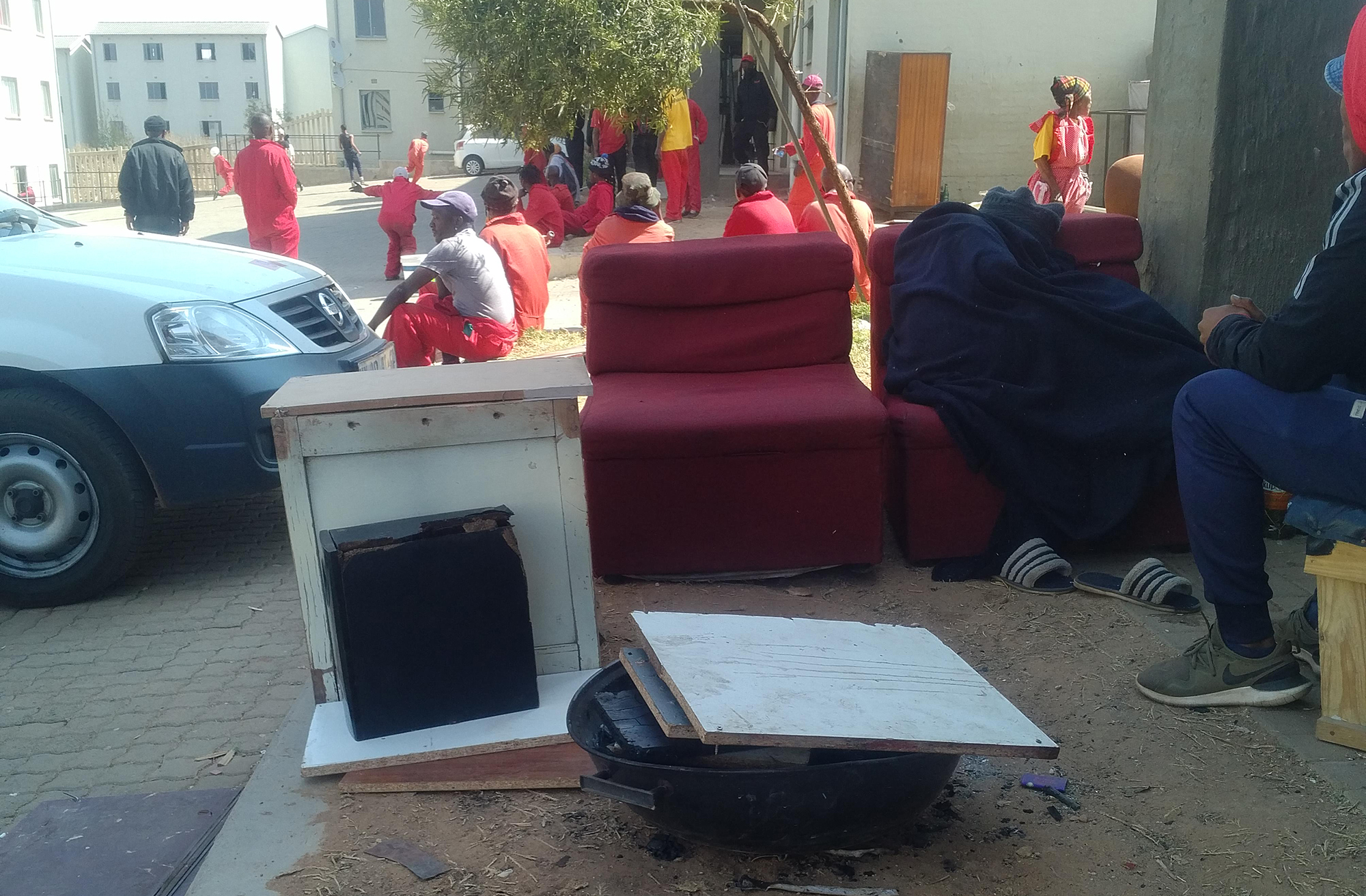
Edith Sihube, 73, points to her neighbours, where her belongings were being kept safe while she and her ailing husband looked after the rest. The Sihubes were evicted after illegally occupying a property since 2017.
A number of pensioners spent several nights out on the street last week after the City of Johannesburg ordered their eviction from a block of flats they had been illegally occupying since 2016.
Several elderly pensioners had to sleep on the street last week after they were evicted from the Fleurhof flats in Soweto they had called home for almost four years.
On Tuesday 25 August the sheriff along with the infamous Red Ants arrived at the flats and evicted about 100 people including pensioners and children. This, according to residents, was the second time the Red Ants had descended on the area in recent weeks, with an earlier eviction taking place on 12 August.
Illegal residents of Fleurhof flats, including many pensioners, spent at least one night on the street to protect what was left of their belongings after members of the Red Ants security evicted them. (Photo: Bheki Simelane)
“The operations were carried out by the sheriff of the court after the developer obtained the eviction order,” said City of Johannesburg spokesperson Nthatisi Modingoane.
“The first operation on 12 August had to be called off after there was a fatality, which is being investigated by the Independent Police Directorate (IPID). The second operation had to be undertaken to enforce the court order and make room for the units to be handed over to government for allocation of rightful beneficiaries.”
Members of the Red Ants Security play soccer on the property’s football pitch a day after they evicted illegal occupants. (Photo: Bheki Simelane)
According to the developer’s website, Fleurhof is a 440ha privately owned property in the process of being developed in partnership with the City of Johannesburg and is set to be one of the largest integrated housing developments in Gauteng. On completion, it will provide housing for an estimated 83,000 people.
Following the 12 August evictions, Human Settlements Minister Lindiwe Sisulu condemned illegal land invasions and said they were perpetrated by people who occupied the flats to strongarm the department to provide them with RDP houses on a preferential basis.
Edith Sihube, 73, told Daily Maverick that she had never had a problem since her arrival in the area in 2017. Sihube was in her house with her ailing husband and family when the Red Ants struck.
“They said nothing except to throw our belongings out,” she said.
Sihube’s ill husband was thrown out of bed, and pleas from Sihube to spare him were ignored. “They don’t want to hear anything, it’s impossible to reason with them,” she said.
Sihube said it was appalling that the very government that they have been voting for over the years was throwing them out on the street.
“When they want you to vote for them they take you to the polling stations, even when you are sick, but this is what we get in return.”
Tshidi Madisakwana, a Meadowlands Community Forum leader, who is also listed as the first respondent in the court order authorising the evictions, said the evictees had nowhere else to go as most had called the place home for almost four years, and some had children enrolled in schools in the area.
“This is a government that doesn’t care,” said Madisakwana.
Residents said they illegally occupied the flats in 2016, and that authorities had not removed them then because they wanted their votes.
“Now they feel it’s the ideal moment, one they think won’t influence our voting patterns. This government has no shame,” said Madisakwana.
Several of the people Daily Maverick spoke to said they were in possession of government C-forms. These forms are an indication that the person had applied for government housing and is on a waiting list. But many don’t believe such a list actually exists.
Said Madisakwana: “Many of those people are from Meadowlands. They have been patiently waiting for houses, but told they are not next in line despite being in possession of C-forms and some having registered in 1996.
“Now that they have thrown the people out, where do they expect them to go, because they have nowhere else to go?” asked Madisakwana.
Many residents stayed up the whole night looking after what was left of their belongings, claiming that several items had been stolen during their eviction.
Shadrack Moabi, 76, who suffers from malignant hypertension, said he arrived in the area in 2017 and had never had a problem until he was thrown out.
“They said nothing. They just tossed out my belongings,” said Moabi.
Moabi’s bed and TV were missing after the eviction, he said.
“Authorities promised us houses; instead, the little that we have is being stolen from us. How would that make you feel?” asked Moabi.
Another eviction victim, 73-year-old Francina Tabola, who also arrived in the area in 2017, said she no longer cared about voting for anyone after supporting the ANC all her life.
“What do I have to show for that, except for a meagre grant? My wish was to die in my own house.”
Tabola said a number of her possessions were stolen during the eviction, including blankets, a phone, a TV and an electric kettle.
“Can this government please come and help us. Why are my things missing?” she asked. When Tabola, who suffers from high blood pressure, spoke to Daily Maverick she had not eaten in 24 hours.
Asked why the flats had remained empty for so long, the City’s Modingoane said the site was still under development and had not yet been handed over to the government for allocation.
Asked where the people evicted should go, Modingoane said, “A court order does not put conditions on the developer. Illegal occupation is a crime and should not be seen as means to be rewarded.”
Modingoane said the eviction did not flout lockdown regulations as “different levels of lockdown come with a different set of rules. The court… take these regulations into account. A competent court of law arrived at a decision to grant an eviction order which got enforced by the sheriff of the court.”